Stem groups' of extinct clades

The notion of a 'stem group' is indespensible for a palaeontologist. Much used and abused, it is simply not possible to talk about the relationships of fossils to modern life without the use of the crown and stem group concepts. The crown group is a clade which is delimited by its living (extant) members. The stem group comprises those fossils which are closer to the crown group than to any other extant clade, but do not fall within the crown group. As a result, the stem group is paraphyletic, and thus not really a group at all. It is perhaps more useful to talk about a 'stem assemblage' than a 'stem group'.

While at this year's SVP (and at previous meetings), I was struck by some of the terminological abuses of the term 'stem group'. In various instances, it was used either to refer to the nearest sister taxa of an extinct clade, or it appealed to essentialist nomenclature. I comment further on these below the fold.

'Stem groups' of extinct clades:
When a clade is extinct is has neither a crown nor a stem. If we did not distinguish between extant and extinct clades when applying the crown group concept, then crown groups could be arbitrarily small and stem groups arbitrarily deep. Because nodes in a cladogram are rotatable, we could use any taxon (fossil or living) to be a stem taxon.

We already have a set of terms for this: sister group relationships. This is also what the crown group concept conveys. However, it's purpose is to convey the relationship of fossils to a particular living group. When we talk about fossil or extant clades, we can talk about the nearest sister taxa. When talking about fossils in relation to an extant clade, only then do we apply the crown group concept.

Arbitrarily deep stem groups
One abstract title at this year's meeting struck me, because it referred to the fossil Morganucodon as the earliest stem-mammal. This taxon is almost certainly a stem-mammal. Is it the earliest? Take a look at this figure (from Angielczyk, 2009) (you may have to click on it to see the full image):


Notice the placement of the node "Mammalia". It's a full two internodes displaced from the node that subtends the extant mammalian branches: monotremes, marsupials, and placentals. You'll also notice that the Triassic fossil Morganucodon is the nearest fossil sister group of the three extant mammal lineages. In other words, it's the nearest sister taxon (in this tree) of the mammalian crown group (which, strangely, is unnamed!).

This is a peculiar trait among palaeontologists: give the standard crown group name (i.e Mammalia, Aves, etc.) to some arbitrary node within the group's stem. For instance, Aves (birds) is often considered to be the clade delimited by the last common ancestor of all extant birds + Archaeopteryx.

What you should also notice in the diagram above is that the root node of this tree is called "Synapsida". This means it entire run of taxa in this tree from the Synapsida node up to (but not including) the unnamed mammalian crown group nodes are part of the mammalian stem assemblage. Yes, Dimetrodon is a stem mammal, as well as Morganucodon. This means that a host of Permian (and potentially earlier) forms are also stem mammals, leaving Morganucodon appearing fairly late in the game.

The utility of the stem/crown group concept comes in placing fossils in relation to living groups. When we do this, fossils can be used to build up knowledge of the sequence of acquisition of homologies where living forms provide no clues. Fossils can, in turn, help test hypotheses of homology by providing unexpected combinations of characters, as well as precluding or 'predicting' certain character combinations. It is important that these concepts are applied in the correct fashion, or else they (and fossils) will lose their meaning.


Angielczyk, K. 2009. Dimetrodon Is Not a Dinosaur: Using Tree Thinking to Understand the Ancient Relatives of Mammals and their Evolution. Evolution: Education & Outreach 2:257–271.

Some graphic images

There's been a report of a snake with a legs and toes in the media recently. The blogosphere has some interesting comments on it, too. Most notably, there is skepticism. Take a look at our snake in question here:


In a comment on Pharyngula, Jerry Coyne notes:
I suspect that this snake ingested a lizard, and that the lizard's limb simply burst through the side of the snake. I may be wrong, and I hope so, because this is great evidence for evolution.

Some graphic images below the fold illustrate why this is not unreasonable speculation.

Snakes sometimes consider their prey choices poorly. Here's a snake with legs and two tails:


(Hat tip to Febble)


Oops! I sort of skipped the first comment at Pharyngula. This commenter noted first that it was probably something the snake ate. Moreover, they note a fact I forgot to mention in my haste: the limb is quite far from where we'd expect the hindlimb to be, if one were to show up. It would be much closer to the tail, not at mid-length of the body. It should be at approximately the same level as the cloaca. There's the unlikely case that it's an atavistic forelimb however, which would raise the issue of where a snake's neck begins or ends.

Deepak the Woo-Meister

It's fun to see somebody with both a knowledge of physics and a sense of humour take on Deepak the Woo-Meister.

fossil of an aquatic animal

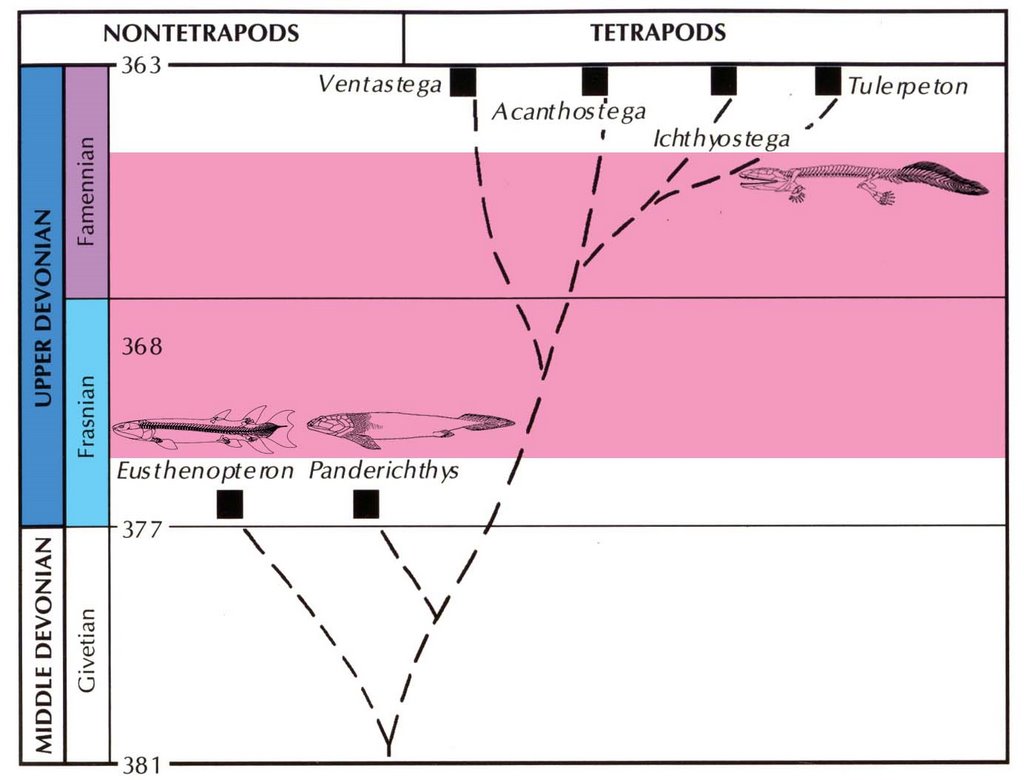
A few years ago, I wrote a post about prediction in the historical sciences. This post came in anticipation of the publication of Tiktaalik roseae, a remarkably well-preserved fossil of an aquatic animal very closely related to the first tetrapods. I offered this figure to illustrate the position of a gap in the fossil record as a predicate for how/where we might look for fossils that would fit within those 'gaps' in phylogeny.


Yesterday, this picture got a lot more complicated. With the publication of tetrapod footprints some 18 million years in advance of this gap by Niedźwiedzki et al., the nice congruence between the node order of the tree and stratigraphy no longer appears so nice.

Here's a picture of the trackways (click for the full view):


[More below the fold]


This news has already broken, and I'm usually the last person to blog about it these days. Naturally, Ed Young has a good take on it. As noted by Jenny Clack in Ed's piece, the individual footprints are more convincing than the trackways in terms of their identity. Here's one from the supplementary information file (which is free to access).

[Picture deleted: I made a mistake, reading too fast and posted an image of Triassic temnospondyl footprints! A better image is this digital surface rendering from the main paper posted below]


But how "bad" is the record now that we know this? Well, bear in mind that lungfishes and tetrapods are considered (at least by the phylogenies in question) to be sister groups. That is, they split from their last common ancestor at exactly the same time. The earliest 'true' lungfishes (i.e. lungfishes with toothplates, and upper jaws fused to the braincase, etc.) are Emsian in age, roughly the same age as these new footprints. Recognizable close relatives of lungfishes, such as Diabolepis, Youngolepis and Powichthys, however, are considerably older. Do, we can set a minimum age for the origin of the tetrapod stem lineage down in very earliest part of the Devonian even if we do not have the fossils.

So, not surprisingly, the record is pretty bad. It's certainly 'gappy'. But we should not be too surprised that tetrapods emerged long before the time when we find their first actual fossils.